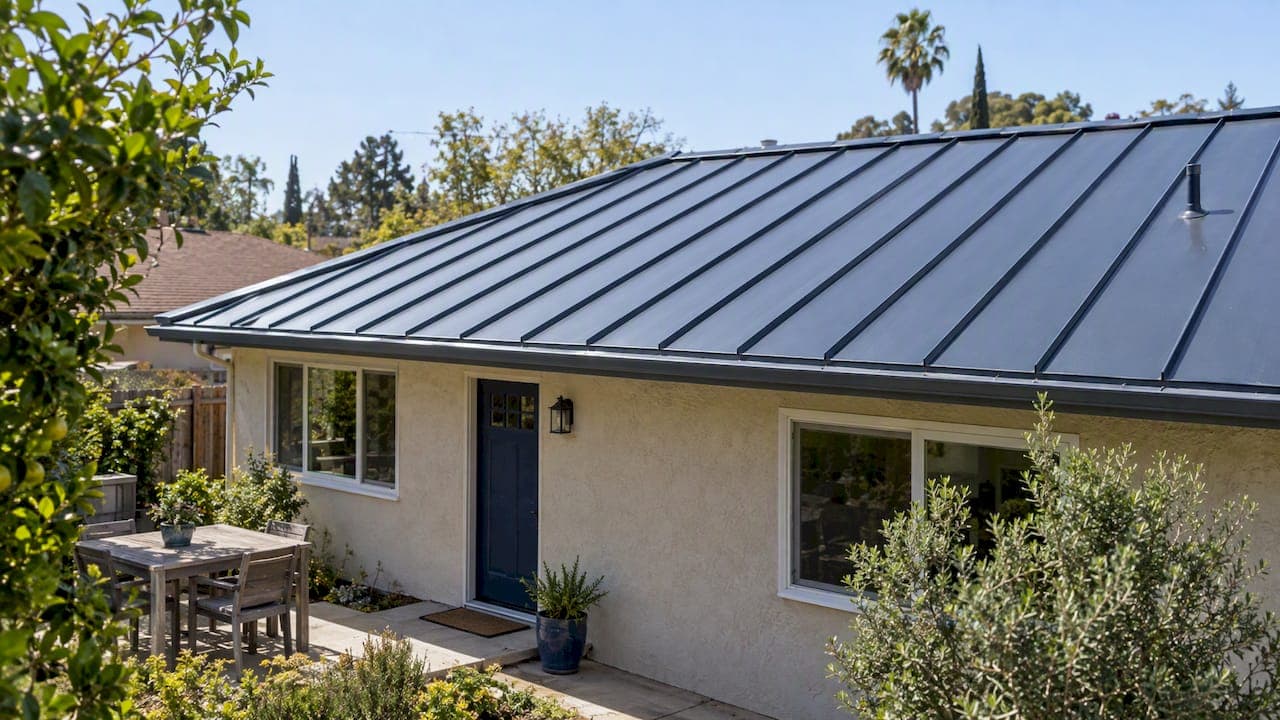
The roofing approach that holds up best in high winds combines a tested covering, standing-seam metal or a Class 4 polymer-modified shingle, with a solid deck, a sealed underlayment, correct fasteners and a continuous load path from roof to foundation. Material alone will not save a roof; installation details decide whether it survives. If you are evaluating a roof or a contractor’s proposal, check for FORTIFIED or manufacturer certification before you sign anything.
TL;DR:
- Ask contractors to document fastener type and spacing, deck sealing, flashing details, and continuous connections from roof to foundation, because installation determines performance.
- A sealed roof deck with secondary underlayment can keep water out after covering damage; FEMA recommends this approach following repeated storm failures.
- UL 2218 Class 4 measures impact resistance, typically from hail, and does not establish wind performance; check ASTM D3161 or D7158 ratings and installation requirements.
- Hip roofs shed wind pressure evenly compared with gable roofs, whose end walls need bracing; after storms, check the attic for stains, damp insulation, or daylight.
Table of Contents
- How wind actually tears a roof apart
- What to look for before you approve any roofing job
- How metal, asphalt, tile, slate and synthetic roofs compare in wind
- Design choices that change whether a roof survives
- Reading the labels: standards and ratings that actually matter
- Spotting wind damage before it becomes a bigger problem
- How we apply this on coastal, high-wind installations
- Stop shopping for a material, start demanding a specification
- Get a wind-resistant roof built to your property’s exposure
- FAQ
- Sources
How wind actually tears a roof apart
Wind does not simply push on a roof, it pulls. As air moves over a roof’s surface, it creates a pressure difference that lifts the covering upward, especially at edges, corners and ridges where airflow separates and accelerates. This uplift force is what rips shingles off one at a time or peels an entire metal panel system loose when it is not fastened correctly.
Once wind finds one weak point, failure tends to cascade. An edge shingle lifts, then wind gets under the next course, then water follows the gap into the deck. A single exposed seam on a metal roof can unzip an entire panel run if the fastening pattern was wrong from the start.
- Edge and corner zones take the highest uplift pressure on any roof shape.
- Wind-driven rain finds its way through gaps long before the covering visibly fails.
- Debris impact can puncture a weakened surface and accelerate water intrusion.
Two structural defenses matter more than any single product choice: a continuous load path that transfers uplift forces safely down through the structure to the foundation, and a sealed roof deck that keeps water out even if the top covering is damaged. Research from the Insurance Institute for Business & Home Safety shows that a continuous load path is often the difference between a roof that survives a severe wind event and one that fails catastrophically.
What to look for before you approve any roofing job
Most wind failures trace back to installation shortcuts, not bad materials. Use this checklist with any contractor bid or product comparison.
- Decking thickness and condition. A solid, properly fastened deck is the foundation every covering depends on; thin, water-damaged or under-fastened decking undermines even a premium roof covering.
- Fastener type, spacing and placement. Nails or screws placed in the correct zone, at tightened spacing for high-wind areas, matter more than the brand printed on the shingle wrapper.
- Sealed deck and secondary underlayment. A taped or sealed deck with a secondary water barrier protects the house even if wind strips the primary covering, a practice FEMA’s mitigation assessments recommend after repeated storm damage reviews.
- Flashing, gutters and penetrations. Chimneys, vents, skylights and gutter attachment points are common starting spots for uplift, and they need the same attention as the field of the roof.
- Installer credentials. A FORTIFIED-certified contractor or a manufacturer-certified installer follows documented nailing and sealing requirements instead of generic practice.
FEMA’s post-storm assessments repeatedly cite incorrect fastener location and partially unsealed shingles as recurring causes of asphalt roof failure, which means the same shingle product can perform very differently depending on who installs it.
Pro Tip: Ask any contractor to show you, in writing, the fastener pattern and deck-sealing method they plan to use, not just the shingle or panel brand.

How metal, asphalt, tile, slate and synthetic roofs compare in wind
No single material guarantees wind performance; each depends heavily on how it is attached.
- Standing-seam metal: When fastened to a solid deck with concealed clips and corrosion-resistant fasteners, standing-seam systems resist uplift well because panels interlock along their full length rather than relying on individual nail points. Coastal installations need stainless or hot-dipped galvanized hardware to keep that connection strength from degrading over time.
- High-performance asphalt shingles: Polymer-modified shingles tested to ASTM D3161 and D7158 can carry high wind warranties when installed with the manufacturer’s specified starter strip, hip and ridge products, and exact nailing zones. Skip one required accessory and the warranty, along with much of the real-world wind performance, disappears.
- Tile and slate: Both are heavy enough to resist simple lift in moderate wind, but individual tiles and slates can be dislodged at edges and ridges if the underlayment and attachment clips are not engineered for the site’s wind exposure. A sealed deck underneath is especially important here, since a cracked tile still leaves a path for water.
- Synthetic shingles: Lighter composite products can combine useful impact resistance with decent wind ratings, but their wind performance still depends entirely on matching the manufacturer’s fastening spec to the home’s wind zone.
- Low-slope membranes: Flat and low-slope roofs rely on mechanically fastened or fully adhered edge details rather than shingle-style overlap; edge anchoring is the single most common failure point on these systems, a detail covered in more depth in our low-slope metal roofing guide.
The pattern across every material is the same: the covering sets the ceiling on performance, but installation determines whether a roof ever reaches it.
Design choices that change whether a roof survives
Roof shape and structural connections often matter more than the covering on top of them.
- Hip roofs outperform gable roofs in wind because their four sloped sides are more aerodynamic and shed wind pressure more evenly, according to Building America Solution Center guidance. Gable roofs need bracing at the end walls to prevent the hinge-style failures that can lead to collapse.
- Moderate pitches and limited overhangs reduce the surface area wind can grab; wide, unsupported overhangs are a common hidden failure trigger, and reinforcing their attachment with engineered connectors cuts uplift risk significantly.
- Continuous load path hardware, straps and connectors that tie the roof structure to the walls and foundation, should be documented by your installer, not assumed. IBHS research identifies this connected system as a core driver of whether a home’s roof survives a severe wind event.
- Decking attachment patterns need to match the local wind zone, with tightened nailing or screw spacing in corner and edge zones.
- Edge details, starter courses, hip and ridge systems, and reinforced flashing, are where most wind-related failures begin, so they deserve the same scrutiny as the field of the roof.
Reading the labels: standards and ratings that actually matter
Product labels reference several distinct test standards, and they measure different things.
- ASTM D3161 and D7158 test asphalt shingles for wind resistance under different simulated conditions; the class rating indicates the wind speed range a shingle has passed, not a guarantee against all failure modes.
- UL 2218 Class 4 measures impact resistance, typically from hail, and is a separate rating from wind performance, so a Class 4 shingle is not automatically a high-wind shingle.
- IBHS FORTIFIED is a voluntary program that sets stricter roof-deck sealing, nailing and installer-certification requirements than most building codes require, specifically to improve wind-driven rain resilience.
- FEMA guidance, including the P-499 series, recommends sealed roof decks, secondary underlayment and documented best practices for metal roof systems in high-wind regions.
Spotting wind damage before it becomes a bigger problem
Catching damage early keeps a repair from becoming a full replacement.
- Walk the perimeter after any significant storm and look for lifted, missing or cracked shingles, dented or creased metal panels, and displaced ridge or hip caps.
- Check the attic for water stains, damp insulation or daylight coming through the decking, all signs of a breach even when the exterior looks intact.
- Treat exposed decking or active leaks as an emergency, with a tarp or temporary patch, and schedule a permanent repair as soon as conditions allow.
- Keep up routine maintenance: check fastener tightness, inspect flashing around penetrations, and clear gutters so water does not back up under roof edges. Our maintenance and inspection service covers this kind of seasonal check for homeowners who want a documented record between storms.
How we apply this on coastal, high-wind installations
We fabricate standing-seam panels to custom specifications, including an 18-inch snap-lock profile built specifically for coastal wind and salt air, detailed on our coastal metal roofing specs page. Every installation goes onto a solid deck with corrosion-resistant fasteners and is backed by a lifetime leak-free warranty. Use the checklist above in any conversation with us, and ask for the specific deck, fastener and sealing details in writing.
Stop shopping for a material, start demanding a specification
Homeowners spend most of their research time comparing shingle brands or metal gauges, when the bigger risk usually sits in the installation details nobody shows them. A correctly fastened mid-tier product will often outlast a premium one installed with shortcuts.
If you take one thing from this, make it this: ask for a documented install plan that names the fastener pattern, the deck-sealing method and the load-path connections, matched to your local wind exposure, not just a product brochure. In coastal areas, corrosion-resistant hardware and a sealed deck are the two upgrades most likely to pay for themselves.
— Marcus
Get a wind-resistant roof built to your property’s exposure
We build standing-seam metal roofs to the wind and salt conditions your property actually faces, fabricating panels on site rather than relying on stock profiles. 
Our standing-seam metal roofing and custom copper options pair with full metal roof replacement or roofing and solar integration under one lifetime leak-free warranty.
Before your consult, gather: photos of your current roof, any known storm or wind damage history, documentation from your last roof installation, and your questions about deck condition and fastener type. Check pricing and request an estimate on our cost page to get started.

FAQ
What is the most wind resistant roofing material?
Standing-seam metal roofing and Class 4 polymer-modified asphalt shingles both offer strong wind performance, but only when installed to the manufacturer’s exact fastening and sealing specifications. The covering sets the ceiling on performance, while installation determines whether a roof reaches it, as outlined in our materials comparison above.
What wind speed can a metal roof withstand?
Wind resistance for a metal roof depends on the panel system, fastening method and deck attachment rather than a single universal number, which is why manufacturer testing and documented installation specs matter more than a generic speed claim. Ask any installer for the tested rating specific to the panel profile and fastening pattern they plan to use.
What does FORTIFIED certification mean for my roof?
FORTIFIED is a voluntary program from the Insurance Institute for Business & Home Safety that requires stricter roof-deck sealing, tightened nailing patterns and certified contractor installation than most building codes mandate. It exists specifically to improve a roof’s resistance to wind-driven rain and uplift, not just wind speed alone.
How do I know if my roof has wind damage I can’t see from the ground?
Interior attic checks for water stains, damp insulation or visible light through the decking often reveal damage before it shows on the roof’s surface. A professional inspection after any major storm catches issues that a ground-level look misses, covered in more detail in the inspection section above.
Is a sealed roof deck worth the extra cost?
A sealed roof deck with secondary underlayment keeps water out even if the primary covering is damaged in a storm, a practice recommended in FEMA’s mitigation assessments following repeated post-storm roof failures. For most homeowners in wind-exposed areas, it is one of the highest-impact upgrades available at install time.
Sources
- Class 3 vs Class 4 shingles: Understanding your options | GAF
- Continuous Load Path – Insurance Institute for Business & Home Safety
- Best Practices for Minimizing Wind and Water Infiltration Damage (FEMA MAT report)
- Hip roof vs gable roof | Building America Solution Center (PNNL/BASC)
- IBHS releases updated resilient construction standards