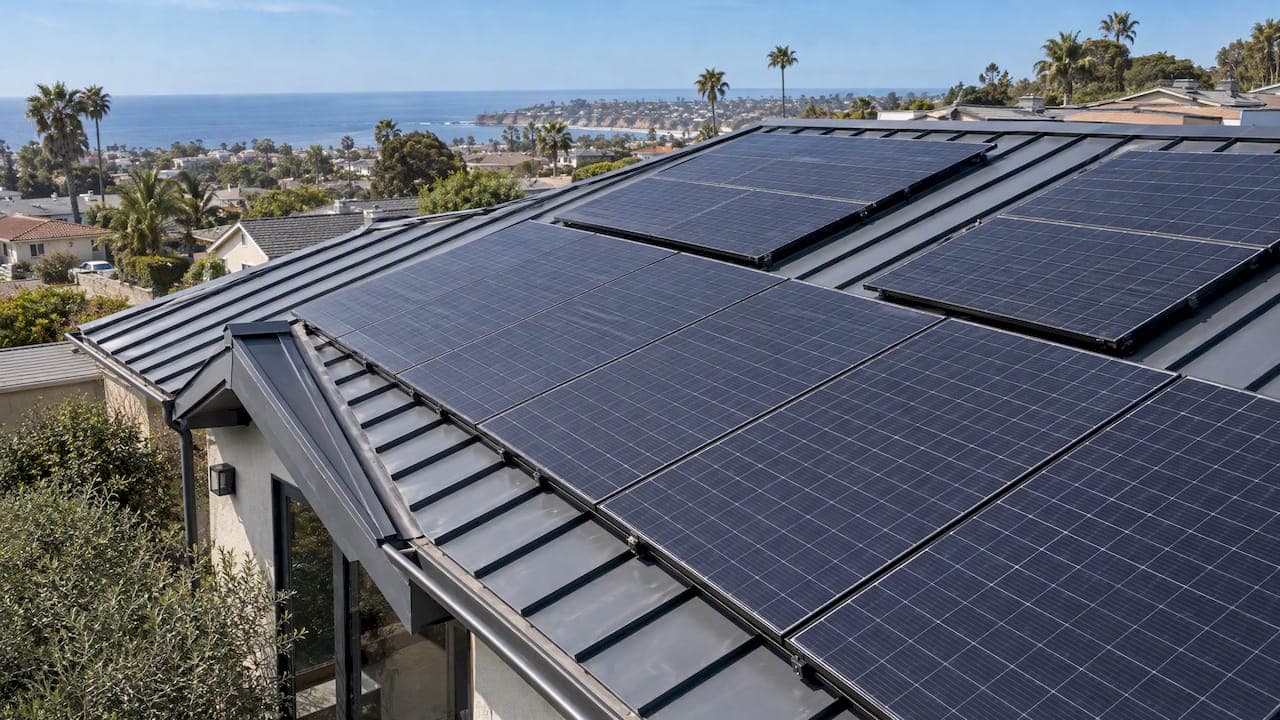
Yes, solar panels go well on a metal roof, and a standing seam roof is the easiest case. Clamps grip the raised seams, so the panels can be attached without drilling through the watertight surface. Other metal profiles can carry solar too, but they usually need engineered, sealed penetrations. What decides whether the system lasts is not the metal itself. It is whether the mounting method suits your exact roof, your wind exposure and your warranties.
TL;DR
- Metal roofs and solar are a strong pairing: metal roofs typically last about 40 years, sometimes up to 70, compared with 12 to 30 years for asphalt, so the roof can outlast the array.
- Standing seam roofs take seam clamps with no roof holes. Corrugated, exposed-fastener and metal shingle roofs generally need profile-specific brackets and sealed penetrations.
- Coastal wind, dissimilar-metal corrosion and gaps between the roofer’s and solar installer’s warranties are the main risks. Get them settled before anything is bolted down.
- If your roof is near the end of its life, replace it first. Removing and reinstalling an array later is an avoidable cost.
Table of Contents
- Why metal and solar suit each other
- Match the mounting method to your roof profile
- Design details that protect the roof
- Wind, salt air and coastal sites
- Warranties: where projects most often go wrong
- Permits and inspection
- How a good installation unfolds
- Should you replace the roof first?
- Multi-unit and commercial roofs
- Our perspective
- Roofing and solar from one team
- FAQ
- Sources
Why metal and solar suit each other
Solar panels are a long-term purchase. Many modules carry 25- or 30-year warranties, so the roof under them should be good for at least that long. A 40-to-70-year metal roof clears the bar. An asphalt roof at 12 to 30 years often does not, which is how homeowners end up paying to detach and re-mount a working array so the roof beneath can be replaced.

The Department of Energy’s checklist for evaluating installed systems makes the same point from the other direction. Its roof criteria include a useful life of 10 or more years remaining for roof-mounted PV. A new metal roof gives you decades of margin on that test.
There is a second advantage. Metal roofs are smooth and predictable, and the attachment hardware for them is mature. The caveat is that predictable only holds when the hardware is chosen for your profile.
Match the mounting method to your roof profile
This is the decision that matters most. Metal roofing is not one product, and the attachment differs by profile.
| Roof profile | Typical attachment | Roof penetrations? |
|---|---|---|
| Standing seam (snap-lock or mechanically seamed) | Clamps that grip the raised seam | Generally none |
| Corrugated and exposed-fastener panels | Brackets or feet fastened through the panel, sealed | Yes, sealed |
| Trapezoidal / ribbed panels | Profile-specific brackets | Yes, sealed |
| Metal shingle and stone-coated steel | Brackets or flashed mounts tied to the structure | Usually yes |
The Building America Solution Center, run by Pacific Northwest National Laboratory, says that except for raised-seam metal roofs, most roof types require penetrations, and that the best attachments tie into structural members. Where a penetration is unavoidable, it should be sealed with a compatible product such as butyl, polyurethane or polysulfide, not whatever tube of caulk is on the truck.
Standing seam: clamps, not holes
Standing seam is the profile solar installers like best. A clamp grips the raised seam, a rail attaches to the clamp, and the panels attach to the rail. The roof surface is never pierced, so the leak path that every penetration creates simply does not exist.

Two cautions apply. First, clamps are made for specific seam shapes and heights, so “standing seam” is not enough information. The seam geometry, the panel gauge and the substrate all need to match what the clamp manufacturer approves. Second, a metal roof expands and contracts with temperature, and the attachment has to allow for that movement. The Metal Construction Association’s white paper on mounting systems stresses that metal roofs behave differently from other substrates, and that keeping the roof intact takes knowledge of metallurgy, sealant chemistry and roof movement, not just electrical skill.
If you are still choosing a profile, our guide to standing seam versus corrugated covers lifespan and trade-offs, and our page on standing seam metal roofing shows what we build.
Corrugated and exposed-fastener roofs
Corrugated panels can carry solar, but the mounts go through the panel. The work is sound when each foot is fastened into the structure below, sealed properly and positioned on the high point of the profile where water does not sit. It is poor when feet are screwed into thin panel metal only. If you have a corrugated roof that is aging, ask whether the fasteners and seals are in good shape before adding dozens of new penetrations. See our corrugated metal roofing page for how that profile is built.

Metal shingle and stone-coated steel
These look like tile or shingle and are installed in small pieces, so there are no long seams to clamp. Mounts are typically flashed and tied to the roof structure. They work, but they should be planned with the roofer, ideally before the roof goes on. Our metal shingle roofing page explains the profile.
Design details that protect the roof
Leave an air gap
Panels lose output when they run hot, and a gap lets air move beneath them. The MCA white paper identifies 4 inches (100 mm) as an optimal minimum offset between module and roof in the studies it cites, with no significant output benefit beyond that. More gap is not better. It just adds wind exposure.
Flush or tilted
Flush mounting follows the roof pitch. It looks cleaner and generally presents less wind exposure. Tilting the array can improve orientation on a poorly facing roof, but it changes wind loading and structural requirements, so it needs its own engineering. On a typical pitched roof facing the right way, flush is the sensible default.
Drainage and access
An array should not dam water or block the ways to a roof drain, a valley or equipment. The Department of Energy’s commercial rooftop guidance names drainage routes and access to existing rooftop equipment as design checks. That matters most for multi-unit buildings, where HVAC units, drains and maintenance routes share the roof.
Fasteners and metals
Mixing metals invites galvanic corrosion, and coastal air speeds it up. Racking, clamps, fasteners and the roof panel itself should be compatible. Our own customers near the water are the reason we pay attention to this, which we get to below.
Wind, salt air and coastal sites
The Department of Energy’s lifecycle guidance says that weather-conscious equipment selection and design can lengthen PV lifetime, and that rooftop systems in high-wind areas should use positive mechanical attachment rather than relying on ballast. On a house, that means the array is anchored to the roof, and the roof is anchored to the structure, in a way that has been calculated for local wind, not assumed.
The MCA is blunt about the stakes: improper PV attachment can become a life-safety hazard is not what it says, so to be precise, the DOE checklist is the source for handover documents, while the MCA white paper is where the attachment warning comes from. In practice, the takeaway is the same: if nobody can show you the attachment design for your roof, do not sign.
For coastal San Diego homes, the combination of onshore wind and salt air argues for a roof built for it. We fabricate an 18-inch snap-lock standing seam profile for coastal conditions, and because our panels are made to your specifications, the seam geometry is known before the solar crew arrives.
Warranties: where projects most often go wrong
A metal roof and a solar array come with separate warranties from separate companies. The gap between them is where disputes start. If a leak appears near an array, the roofer can point at the solar crew and the solar crew can point at the roof.
The Department of Energy notes that major components often carry about 25-year warranties in the program guidance it cites, and that inverter warranties are usually 10 years. It also recommends checking insurance coverage and installation issues such as roof penetrations. Before signing, get answers in writing:
- Does the roof warranty stay valid when solar is attached, and by what method?
- Who is responsible if a leak appears near a mount?
- Who removes and reinstalls the array if the roof needs work?
- Which documents arrive at handover?
On that last point, the DOE checklist lists what a complete file includes: permits, electrical design, contractor and manufacturer warranties, a parts list, operating instructions, disconnect procedures and emergency contacts.
The same logic applies to anything else you attach to the roofline. If you are planning permanent roofline lighting alongside solar, it is worth reading about which track materials hold up outdoors so you are not adding a weak point to a roof meant to last decades.
Permits and inspection
Expect permits before the system is switched on. U.S. projects commonly involve building and electrical permits, local zoning or HOA review where applicable, and a final inspection, and the rules vary by city and county. For commercial and multi-unit buildings, the design should meet local snow and wind codes and be approved by a licensed engineer where required. In San Diego, check with the permitting office for your jurisdiction, since the city, the county and the smaller coastal cities each run their own process. Ask your contractor which agency applies to your address and who files.
Timelines are site-specific. Permitting, engineering, roof replacement, utility interconnection and weather all move the schedule, so ask for a written timeline after the roof and electrical assessment, not before.
How a good installation unfolds
The DOE’s installation and commissioning guidance outlines a sequence that holds up on a metal roof:
- Assess roof age, profile, slope, structure, shading and electrical service.
- Select racking compatible with the roof profile.
- Engineer the wind, snow and seismic attachment.
- Coordinate the roof and solar warranties.
- Permit the project.
- Install clamps or flashed penetrations, then modules, wiring, inverter and safety equipment.
- Inspect and commission, then receive full documentation.
This is the sequence the Department of Energy lays out. Notice that the racking choice comes before the permit and long before anyone is on the roof. The MCA’s practitioner guidance makes the same argument: the roofing and PV trades should coordinate before fabrication, not improvise brackets after panels arrive.
Should you replace the roof first?
If your roof has less than about ten years of life left, yes, usually. Putting solar on a tired roof means paying twice: once to install and once to detach, store and reinstall. The cost of replacing a roof depends on size, profile and complexity. Our metal roof replacement projects run from $40,000 to $60,000, and you can see what that covers on our metal roof replacement page. Treat it as a range, not a quote, since your roof’s size and details set the real number.
If the roof is already metal and in good shape, you may only need an inspection to confirm the seams, fasteners and coating can carry an array. Our maintenance and inspection service covers that check. If something is already leaking, fix it before any solar goes up, and our leak repair guide shows the common failures.
Multi-unit and commercial roofs
For property managers, the questions are different. Arrays are larger, access and drainage matter more, and the roof usually carries mechanical equipment. The DOE commercial guidance points to engineer approval and building-authority sign-off where required. Plan the array layout around HVAC, drains and service routes, and make sure the roof and solar warranties fit together. Our commercial metal roofing work is built around durable roofs for multi-unit buildings.
Our perspective
We build metal roofs in San Diego, and the pattern we see is simple: solar trouble almost never starts with the panels. It starts with a roof nobody planned the array around.
That is why we fabricate panels to specification and treat the solar layout as part of the roof design. When we know where the array goes, we can make sure the seam profile, the attachment points and the flashing details are settled first. We do the installation with our own crews, not subcontractors, because the person who knows the roof should be the person on it.
For the coastal homeowner, we lean toward standing seam with our 18-inch snap-lock profile. It lets the array attach to seams instead of the roof surface, and it is built for wind and salt air. Our work carries a lifetime leak-free warranty, and we handle the solar integration so you deal with one team rather than two companies pointing at each other.
Our advice is the same whether you hire us or not: ask for the attachment method in writing, ask who owns a leak, and do not accept “we do this on every roof” as an answer.
— Marcus
Roofing and solar from one team
If you are planning a new roof and solar together, or you want to know whether your current metal roof can carry an array, talk to SW Metal Roofing. We fabricate custom standing seam panels in San Diego, coordinate the solar integration, and back the roof with a lifetime leak-free warranty. You can also look through our completed projects to see the profiles.
FAQ
Is it good to put solar panels on a metal roof?
Yes, in most cases. Metal roofs commonly last long enough to outlive the array, and standing seam roofs allow clamp mounting without penetrations. The condition is that the attachment is engineered for your specific profile and wind exposure.
Do solar panels void a metal roof warranty?
They can if the mounting method is not approved by the roof manufacturer or installer. Get written confirmation that the roof warranty stays in force with solar attached, and ask who is responsible for a leak near a mount.
Do you have to drill into a metal roof to install solar?
Not on a standing seam roof, where clamps grip the raised seams. Corrugated, exposed-fastener and many metal shingle roofs generally need sealed penetrations tied into the structure, according to PNNL’s Building America guidance.
How much maintenance do solar panels on a metal roof need?
Very little. Rooftop PV has no moving parts, and the Department of Energy says rain usually keeps panels clean enough. In long dry spells, a directed hose rinse is generally sufficient if they get particularly dirty. Follow your equipment warranty’s maintenance terms.
Should I replace my roof before adding solar?
If the roof is near the end of its useful life, yes. Installing over it can mean paying to remove and reinstall the array later. A roof with many years left only needs an inspection.
Sources
- Can I Install Solar Panels On a Metal Roof? (EnergySage)
- Roof Anchor System for Solar Panels (Building America Solution Center)
- Metal Roofing and Solar PV Systems: Mounting System Methods, Part 2 (Metal Construction Association)
- Life Cycle of Photovoltaic Systems: Install and Commission a Photovoltaic System (U.S. Department of Energy)
- Commercial Rooftop Solar, Frequently Asked Questions (Better Buildings Alliance)
- Solar PV Post-Evaluation Checklist (U.S. Department of Energy)
- Solar consumer guide (U.S. Department of Energy)