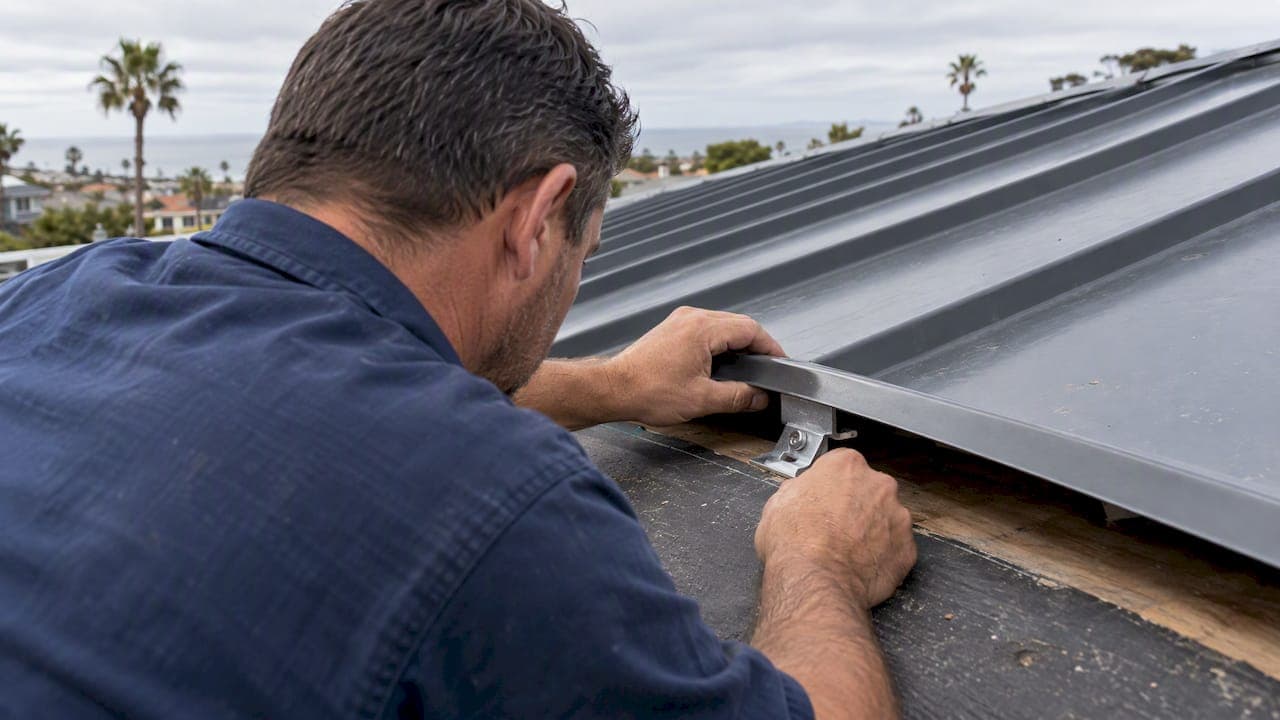
A hidden fastener metal roof is a panel system where the screws or nails that hold the roof down are covered by the panels themselves. The panels lock together at raised seams, and clips under the seams anchor them to the deck. Rain never meets a fastener head, which is the main reason these roofs leak less and last longer than exposed-screw roofs. They cost more up front. For most homeowners planning to stay put, the math still tends to favor them.
Below, we explain how the system works, where hidden fasteners help and where they don’t matter, what coastal San Diego adds to the picture, and what to ask a contractor before signing.
TL;DR
- Hidden (concealed) fastener roofs, mostly standing seam, attach panels with clips under interlocking seams, so no screw heads sit in the weather.
- Exposed-fastener roofs are cheaper to install, but the screws, washers and holes are the usual failure points and need periodic checks.
- Hidden fastener roofs let panels expand and contract with temperature, and they allow clamp-on solar mounting with no holes in the metal.
- Near the coast, the fasteners and clips hidden under the panel matter as much as the panel: stainless steel or hot-dipped galvanized is the standard to ask for.
- Expect a higher initial price, lower maintenance, and a roof that outlasts asphalt by decades.
Table of Contents
- What “hidden fastener” actually means
- Hidden vs. exposed fasteners
- Where hidden fastener roofs still leak
- Wind, fire and impact ratings
- Coastal San Diego: the fasteners you can’t see still corrode
- Solar: the quiet advantage of a seamed roof
- Does a hidden fastener roof cost more?
- Our perspective
- How to choose: a short checklist
- Working with SW Metal Roofing
- FAQ
- Sources
What “hidden fastener” actually means
The terms hidden fastener, concealed fastener and standing seam get used almost interchangeably, and that is mostly fine. Concealed fastener panels are joined by an interlocking seam and held by fasteners or clips tucked under the panels. Most are steel, though aluminum and copper exist.
There are two ways the seam is made:
- Snap-lock: the edge of one panel snaps over the edge of the next. No special tool is needed on the roof, installation is quick, and the look is clean.
- Mechanically seamed: a seaming tool folds or crimps the seam closed on the roof. It is slower and costs more labor.
In both cases the clip or fastener sits under the panel, not through its face. A structural design guide from a panel manufacturer notes that snap-together systems offer ease of installation and a clean look, while mechanically seamed systems offer more weather-tightness and structural capacity, especially on long panel runs. Neither one is simply “better.” The right choice depends on your roof slope, panel length, wind exposure and budget.
Hidden vs. exposed fasteners
Exposed-fastener roofing, usually corrugated or ribbed panels, is screwed straight through the face of the panel into the deck. Each screw has a rubber or neoprene washer that has to keep sealing for decades while the metal moves under it.
| Hidden fastener (standing seam) | Exposed fastener | |
|---|---|---|
| Fastener location | Under the panel, in clips | Through the panel face |
| Leak points | Seams and details (flashings, penetrations) | Every screw, plus details |
| Thermal movement | Clips or slots let panels slide | Holes can elongate or tear |
| Maintenance | Periodic inspection | Periodic screw checks and replacement |
| Solar mounting | Clamps to the seams | Drilling through panels |
| Upfront cost | Higher | Lower |
| Look | Clean, uninterrupted lines | Visible screw rows |
The weak spot of exposed systems is physical. Exposed fastener systems suffer damage from panel movement and are more prone to leaks and corrosion around fastener heads, while hidden systems use clips or slots to absorb that movement.
Why thermal movement matters
Steel grows and shrinks with temperature. One common rule of thumb in the industry is to allow about 1/8 inch of movement per 10 feet of steel panel length. On a 30-foot panel, that is roughly three-eighths of an inch, twice a day, for decades. A screw fixed through the panel fights that motion and can wear its hole oversized. A sliding clip simply lets the panel move.

That is the practical argument for hidden fasteners: you remove the part most likely to fail.
Exposed fastener is not “bad”
Corrugated and ribbed panels are a legitimate choice for sheds, garages, barns and budget-driven projects, and many last a long time with attention. The trade is simple: lower price now, more maintenance later. If you want to compare the profiles for a home, our guide on standing seam versus corrugated for homeowners walks through lifespan and upkeep.
Where hidden fastener roofs still leak
Hiding the screws does not make a roof leak-proof. After the panel field, the leaks that remain are at details:
- Chimneys, skylights and vents
- Valleys, eaves and ridges
- Wall transitions and flashing laps
- Any place a trade cut or drilled through the roof afterward
Penetrations are where workmanship decides the outcome. Gaps around a chimney chase, for instance, can leak air and moisture from the attic side too, and sealing chimney chase gaps from the attic with sheet metal is the sort of detail worth checking when you inspect a roof from inside. Ask any contractor who installs your flashings, and how.
Wind, fire and impact ratings
Panels are not just “metal.” The system gets tested as a whole. Concealed-fastener assemblies are evaluated under standards such as UL 580 for wind uplift, UL 790 for fire, ASTM E1646 and E2140 for water infiltration, and UL 2218 for impact resistance. Those results belong to specific panel, clip, deck and attachment combinations, so a rating on one product does not transfer to another installed differently.
When a contractor quotes you, ask which tested assembly the roof matches: panel gauge, clip type, clip spacing and deck. For wind-prone locations, the same design guide says mechanically seamed systems are the recommended option where uplift demands are high. For more on wind design, see our guide to wind-resistant roofing and FORTIFIED specs.
Coastal San Diego: the fasteners you can’t see still corrode
Salt air is the biggest enemy of any roof within a short distance of the ocean or bay. FEMA guidance for coastal metal roofs says that within 3,000 feet of a body of water producing salt spray, connectors and fasteners should be hot-dipped galvanized steel or, preferably, stainless steel. The document was written for the Northern Mariana Islands, but the corrosion logic applies to any salt-spray environment, including much of the San Diego coast.
Hidden fasteners help here because there is less exposed hardware to rust. They do not remove the need to choose the right materials. In coastal areas, ask for:
- Stainless or hot-dipped galvanized clips and screws, in writing.
- A panel coating suited to salt exposure, with its warranty terms.
- Matching metals throughout, so dissimilar metals don’t corrode each other at contact points.
- Gutters, flashings and trim in compatible materials.
This is why we fabricate an 18-inch snap-lock profile designed for coastal wind and salt air. Panels are made to your roof’s specifications, not trimmed from a stock length.
Solar: the quiet advantage of a seamed roof
If solar is in your plans, the roof type matters. On an exposed-fastener roof, mounting hardware generally means drilling through panels, which creates new leak points. Standing seam roofs allow clamps, such as the S-5! system, that grip the seams without penetrating the metal, so the weather barrier stays intact.

That also changes the sequencing. A metal roof is a 40-plus-year decision, and solar arrays often go on after. Planning both together avoids pulling arrays off to repair roofing later. Our post on standing seam metal roofs and solar in San Diego covers how that works in practice.
Does a hidden fastener roof cost more?
Yes, at the start. Concealed-fastener roofs typically carry a higher initial investment because of heavier gauge metals and more labor-intensive installation. The same source says lower maintenance and a longer service life, often two to three times that of asphalt shingles, frequently give homeowners a better return over time. That is a manufacturer’s claim, so treat it as a general pattern and not a promise for your house.
For a replacement on a typical home, our published range for metal roof replacement is $40,000 to $60,000 one-off. The final figure depends on:
- Roof size, pitch and complexity (valleys, dormers, penetrations)
- Panel profile, gauge and finish
- Tear-off needs and deck repairs
- Solar, gutters and other integrated work
- Material: steel, stone-coated steel or copper
We don’t publish per-square-foot prices for the other options, because roofs vary too much to quote responsibly without measuring. You’ll find an overview of the options on our cost and materials page.
Coating and color
Dark metal roofs look sharp but absorb heat. The Department of Energy has published research showing that advanced coatings combining near-infrared reflectance and fluorescence can improve solar reflectance for dark-colored metal roofs. In practice, ask for a cool-roof rated finish, especially on darker colors.
Our perspective
We build standing seam roofs in San Diego, and we see the same pattern in roof failures: it’s rarely the metal itself. It’s a fastener, a flashing, or a penetration someone cut afterward. That is why we lean toward hidden fastener systems for homes. They take the largest group of small, repeated failure points off the roof.
We also don’t think the profile is the whole answer. A well-made panel with sloppy flashing will still leak. That’s why we keep installation in-house rather than subcontracting it, fabricate panels to the roof’s dimensions, and put a lifetime leak-free warranty behind the work. When solar is part of the project, one team handles both, so no one is left arguing about whose hole it was.
Our honest advice: if you plan to stay in the house ten years or more, live near the coast, or want solar, pay for hidden fasteners. If it’s a detached garage or a tight budget, exposed fastener is a reasonable choice.
— Marcus
How to choose: a short checklist
- Match the system to the roof. Check the slope and panel length. Long runs and high wind favor mechanically seamed. Moderate runs and fast installation often suit snap-lock. For very low slopes, see our notes on low slope metal roofing.
- Get fastener material in writing. Stainless or hot-dipped galvanized near the coast.
- Ask who installs. Your crew or a subcontractor? Who does the flashings?
- Read the warranty. What does it cover: panel finish, leaks, labor? Who stands behind it, and for how long?
- Plan solar first. Decide before the roof goes on, even if panels come later.
- Check the permit and code path with your city or the county building department.
Working with SW Metal Roofing
We design, fabricate and install standing seam roofs in San Diego, including the 18-inch snap-lock profile for coastal conditions, stone-coated steel and copper, with solar integration and seamless gutters. If you want a clear read on your own roof, start with our standing seam metal roofing service or contact us through the main site for an estimate. Already have a metal roof with issues? Our repair and maintenance and inspection services are where we’d begin.
FAQ
How do you install a metal roof with hidden fasteners?
Panels go over an underlayment on a solid deck. Clips are fastened to the deck, then each panel’s seam engages the clip and the neighboring panel, either snapped or mechanically crimped. The next panel hides the previous panel’s fasteners. Flashings and trim are then added at edges and penetrations. This is detail work, so it is best left to an experienced installer.
How long will an exposed fastener metal roof last?
It depends on the panel, coating and climate, but the screws and washers are usually the limiting factor, not the metal. Periodic screw checks and replacements extend its life. Manufacturers say hidden fastener designs avoid the regular tightening or replacing of rusted exposed screws.
Is it possible to have a metal roof without exposed fasteners?
Yes. Standing seam and other concealed fastener panels have no screws in the visible panel face. Some trim and flashing details may still use fasteners, but they are placed where they are covered or sealed.
What does a hidden fastener metal roof cost?
More than an exposed fastener roof at installation. Our published range for a metal roof replacement is $40,000 to $60,000, and the exact price depends on size, complexity, material and add-ons like solar or gutters.
Sources
- Concealed Fastener Metal Roof Panels, Metal Sales
- Concealed Fastener Steel Roof and Wall Panel Structural Design Guide, AEP Span
- SpanSeam Metal Roofing, AEP Span
- Exposed vs Concealed Roofing Screws, SFS USA
- Code-Based Wind-Resistant Roofing for Homes, FEMA
- Cool roof coatings for dark metal, U.S. Department of Energy