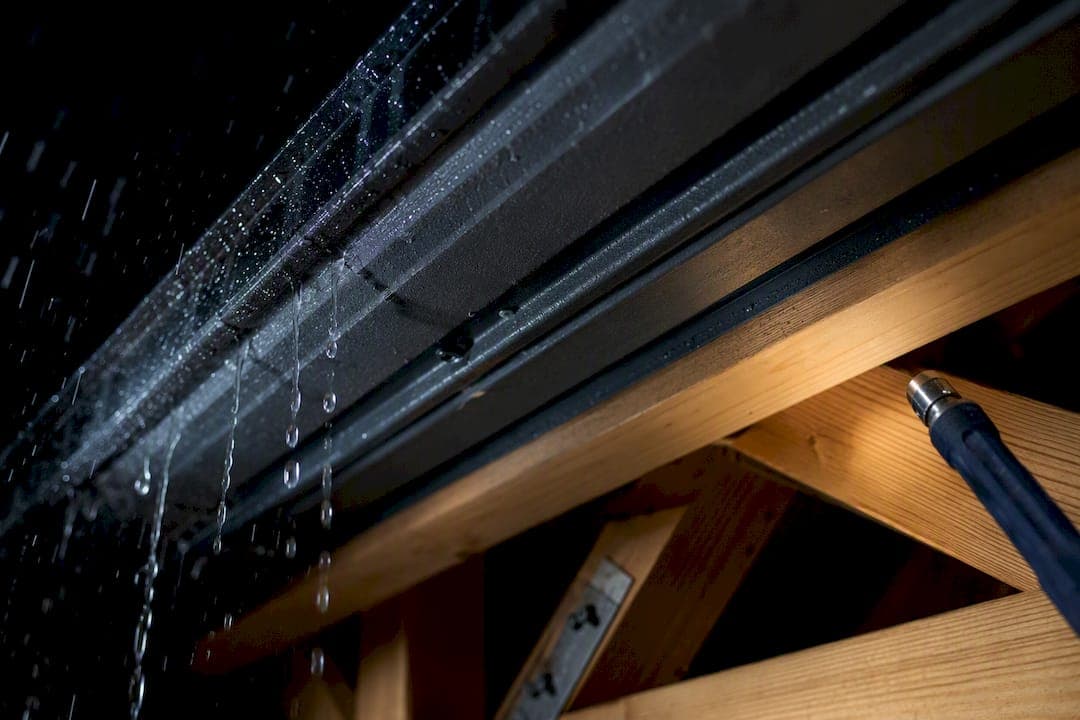
The fastest way to quiet a metal roof is to attack the panel itself: bond a damping compound or mass-loaded vinyl to the underside, then pack the cavity with insulation. Rain hits metal as impact noise, so the sheet vibrates like a drumhead, and foam on the ceiling alone won’t stop that. Lab testing on damping systems shows significant decibel drops are realistic when mass and absorption work together.
TL;DR:
- Using a combination of damping compounds and cavity insulation yields the best rain noise reduction, with improvements of up to 20 decibels.
- Applying damping or mass directly to the underside of the panel before filling the cavity with mineral or glass wool is key to effective soundproofing.
- Seal every seam, gap, and penetration with tape to prevent sound leaks and ensure maximum acoustic performance.
- During re-roofing, specifying a heavier deck and tighter fastener spacing can improve noise control at minimal additional cost.
- Cold, humid weather can hinder damping compound curing, so plan retrofits during stable weather conditions for optimal results.
Table of Contents
- What Are the Best Soundproofing Metal Roof Methods for Your Situation?
- How Does Rain Noise Actually Form on a Metal Roof?
- Which Materials Actually Work, and Where Do You Put Them?
- How Do You Actually Install Soundproofing on a Metal Roof?
- What Performance Can You Realistically Expect?
- What Does It Cost, and What Mistakes Waste Money?
- Why SW Metal Roofing Treats Acoustics as Part of the Build, Not an Afterthought
- Sources
- FAQ
What Are the Best Soundproofing Metal Roof Methods for Your Situation?
Not every fix suits every roof. Your access, budget, and timing (retrofit versus re-roof) decide which method actually makes sense.
- Bonded liquid damping works best when the underside is exposed or you’re already re-roofing and can reach bare metal.
- MLV plus an acoustic mat (a BassBloc-style layered approach) fits tight attics or finished ceilings where you can’t easily strip drywall.
- Cavity fill with dense mineral wool or glass wool pays off on wide-span roofs where there’s room between framing to pack material without compressing it flat.
- Acoustic underlayment installed during a re-roof costs less per square foot than any retrofit, since labor is already happening.
- Panel profile, gauge, and fastener spacing matter most on new installs, where a heavier gauge and tighter screw pattern quiet the roof before you add a single acoustic product.
Most homeowners end up combining two of these rather than picking one. A liquid damper on the panel plus a mineral wool cavity fill, for example, tackles both the vibration and the resonance at the same time.
How Does Rain Noise Actually Form on a Metal Roof?
Rain doesn’t produce airborne sound the way a stereo does. Each drop is a tiny mechanical impact, and a thin metal panel behaves like a drumhead: it flexes, rings, and radiates that energy as noise into the room below. That’s why installer guidance consistently stresses treating the sheet itself rather than only absorbing sound after it’s already in the air.
Damping compounds work by converting that vibration into heat through internal friction in the coating, which cuts the panel’s ability to ring. Added mass, whether from MLV or a thicker substrate, reduces how far the metal accelerates under each impact, which lowers the volume at the source rather than muffling it downstream.
Empty cavities between the deck and ceiling act like a resonant chamber, amplifying certain frequencies the way a guitar body amplifies a plucked string. Filling that space with insulation breaks up the resonance instead of just adding a layer of fluff. Different treatments target different frequency bands too: mass tends to knock down higher-pitched patter, while damping and cavity fill do more work on the lower rumble that carries through framing.
Which Materials Actually Work, and Where Do You Put Them?
Product choice depends on access and budget, but the materials themselves fall into four categories.
Liquid damping compounds like Decidamp SP80 go on the underside of the panel with a roller or spray gun. You need roughly 1 mm dry film thickness for the compound to do meaningful work, applied in multiple thin coats rather than one heavy pass. Surface prep matters: clean and degrease the metal first, and only apply above about 50°F, since cold or humid conditions keep the compound from curing properly.
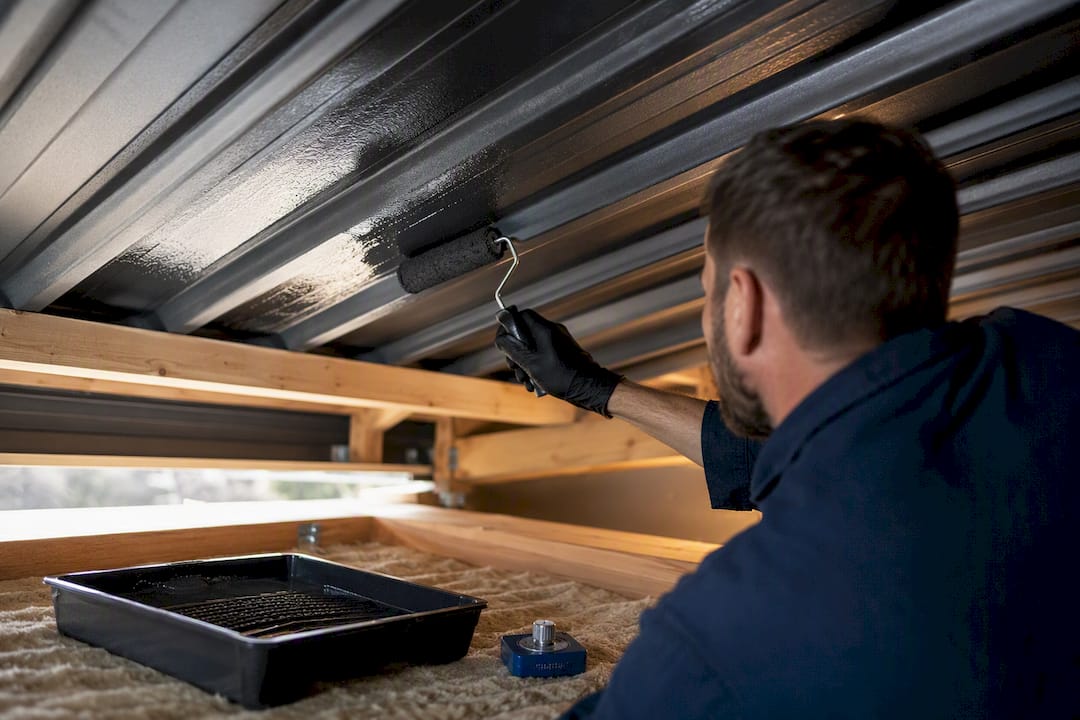
Mass-loaded vinyl and acoustic mats (the BassBloc approach) get mechanically fastened or adhered directly to the panel or purlins, then covered with a finish layer so the material isn’t left exposed to moisture or UV. MLV adds pure mass, which resists vibration without needing a cure window, making it the better choice for cooler climates or rushed timelines.
Insulation splits into two camps. Glass wool and mineral fiber consistently outperform spray polyurethane foam in acoustic lab testing, largely because their open, fibrous structure absorbs sound energy across a wider frequency range. Foam insulates for temperature well but does comparatively little for sound, and it can trap moisture against the deck if not detailed carefully.
Underlayment synthetic or rubberized asphalt sheets decouple the panel from the deck, which reduces how much vibration transfers downward. Sealing every rib and closure with butyl or elastomeric tape closes the small gaps where sound otherwise leaks and panels rattle against fasteners.
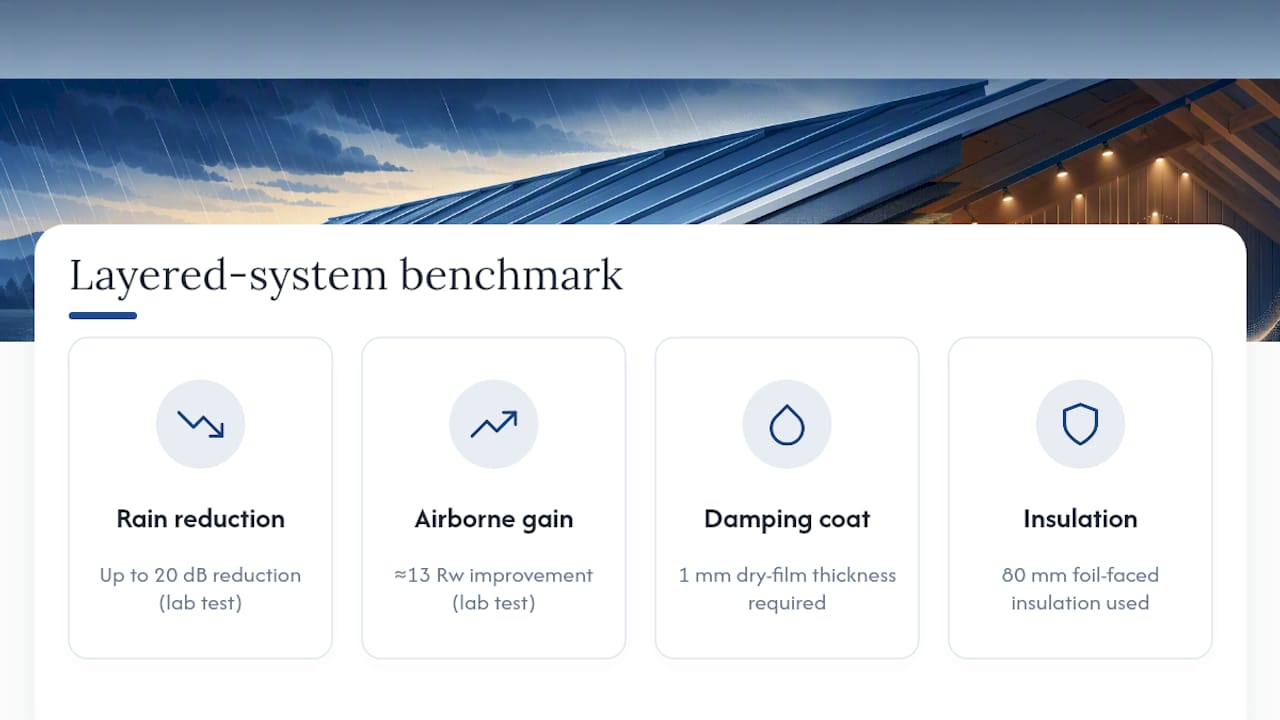
Lab testing on a 1 mm DFT damping compound paired with 80 mm of foil-faced insulation showed rainfall noise improvements of up to 20 dB combined, with airborne transmission loss gains near 13 Rw points, a useful benchmark for what a layered system can realistically achieve.
How Do You Actually Install Soundproofing on a Metal Roof?
The steps differ depending on whether you’re retrofitting an existing roof or planning acoustic treatment into a new install.
Retrofit on an existing roof:
- Inspect the deck, fasteners, vents, and penetrations for damage or gaps before adding anything.
- Clean and degrease the underside of the panel thoroughly.
- Apply damping compound in thin coats, or bond MLV directly to the metal.
- Add an acoustic mat or mineral wool layer over the damping treatment.
- Seal all seams, rib closures, and penetrations with butyl or elastomeric tape.
- Test with a hose or wait for the next rain to confirm the improvement before finishing the ceiling.
New install or full re-roof:
- Specify a heavier deck, typically 15/32-inch CDX plywood or OSB.
- Install a synthetic or rubberized acoustic underlayment across the full deck.
- Pack the cavity with mineral wool or glass wool without compressing it flat.
- Fasten panels at tighter screw centers to cut vibration paths.
- Close out the ceiling assembly once every layer is in place.
Liquid dampers need several consecutive dry days above 50°F to cure fully, so plan retrofit work around a stable weather window, not a single sunny afternoon. Cold snaps or surprise humidity are the most common reason a damping job underperforms.
What Performance Can You Realistically Expect?
Lab numbers provide an estimate of possible improvements, serving as a helpful benchmark for expectations.
| Treatment tested | Measured improvement | Test basis |
|---|---|---|
| Decidamp SP80 at 1 mm DFT | about 10 to 11 dB rainfall noise reduction; 5 to 6 Rw points | ISO-based lab testing |
| Damping compound + 80 mm insulation | Up to ~20 dB rainfall noise; ~13 Rw points | AAS 2018 conference paper |
| Multilayer glass wool + damping systems | reduce sound transmission by significant decibel amounts in certain configurations | ISO 10140 lab testing |
Real-world results move around based on panel profile, frame spacing, and whether you’re measuring in a controlled chamber or a working attic. A combination of damping and cavity fill produces more consistent gains across frequencies than either method alone, which is the main reason single-product fixes tend to disappoint.
What Does It Cost, and What Mistakes Waste Money?
Cost swings mainly on three factors: whether you choose MLV or liquid damping, how much labor and access the job needs, and whether the decking or panels get replaced along the way. Liquid coatings need several clear, dry days to fully cure, so rushing the timeline is the single most common way a damping job fails to bond right.
- Relying on foam-only ceiling insulation and expecting it to quiet rain impact noise.
- Skipping seals at penetrations and rib closures, leaving easy paths for sound and rattle.
- Applying liquid damper in cold or humid weather, which prevents proper cure.
- Reusing old, brittle underlayment instead of replacing it during a re-roof.
Pro Tip: Seal every gap and penetration before you spend a dollar on damping material. A perfectly bonded coating can’t compensate for sound leaking around an unsealed vent stack.
If you’re re-roofing anyway, specifying a heavier deck and closer fastener spacing costs relatively little extra and pays off in quieter performance for the life of the roof, since solid decking with a quality synthetic underlayment keeps a metal roof from sounding dramatically louder than asphalt shingles.
Why SW Metal Roofing Treats Acoustics as Part of the Build, Not an Afterthought
SW Metal Roofing fabricates custom standing seam systems in San Diego, including an 18-inch snap-lock profile built for coastal wind and salt air, and we bake acoustic detailing into that process rather than bolting it on later. Heavier gauge panels, tighter fastening, and quality underlayment all get specified up front, backed by a lifetime leak-free warranty. If your roof spans a large area or involves complex flashing, a professional install protects both the warranty and the acoustic result. Request an inspection or quote if you’d rather have it done right the first time.
Sources
- AAS 2018 conference paper (damping compound rainfall tests)
- Attenuation of rainfall noise on metal roofing | Decidamp® SP80
- Acoustic performance of covering systems with metallic roof tiles: effect of damping layers on rain noise
- How to Soundproof a Metal Roof: Rain & Noise – MMT Acoustix
FAQ
How Do You Stop Metal Roof Noise From Rain?
Add damping or mass directly to the underside of the panel, then fill the cavity beneath it with insulation. Bonded liquid dampers and MLV both cut the panel’s vibration, which is the real source of rain noise, rather than just absorbing sound after it’s already radiating into the room.
Is Sound-Deadening Treatment for a Metal Roof Worth the Cost?
Yes, for most homeowners who find rain noise disruptive. Lab tests show liquid damping compounds can cut rainfall noise by 10 to 11 dB, a difference most people notice immediately during a storm.
Why Is My Metal Roof So Loud When It Rains?
Metal panels flex and ring under each raindrop’s impact, acting like a thin drumhead with little natural damping. Empty cavities beneath the panel can also resonate and amplify certain frequencies, which is why filling that space with insulation matters as much as treating the metal itself.
How Can I Soundproof My Roof From Rain Noise on a Budget?
Start by sealing every seam, rib closure, and penetration with butyl tape, since gaps let sound leak and panels rattle loose. From there, mineral wool cavity fill combined with a mid-grade MLV layer gives you a meaningful reduction without the labor cost of a full liquid damping application.